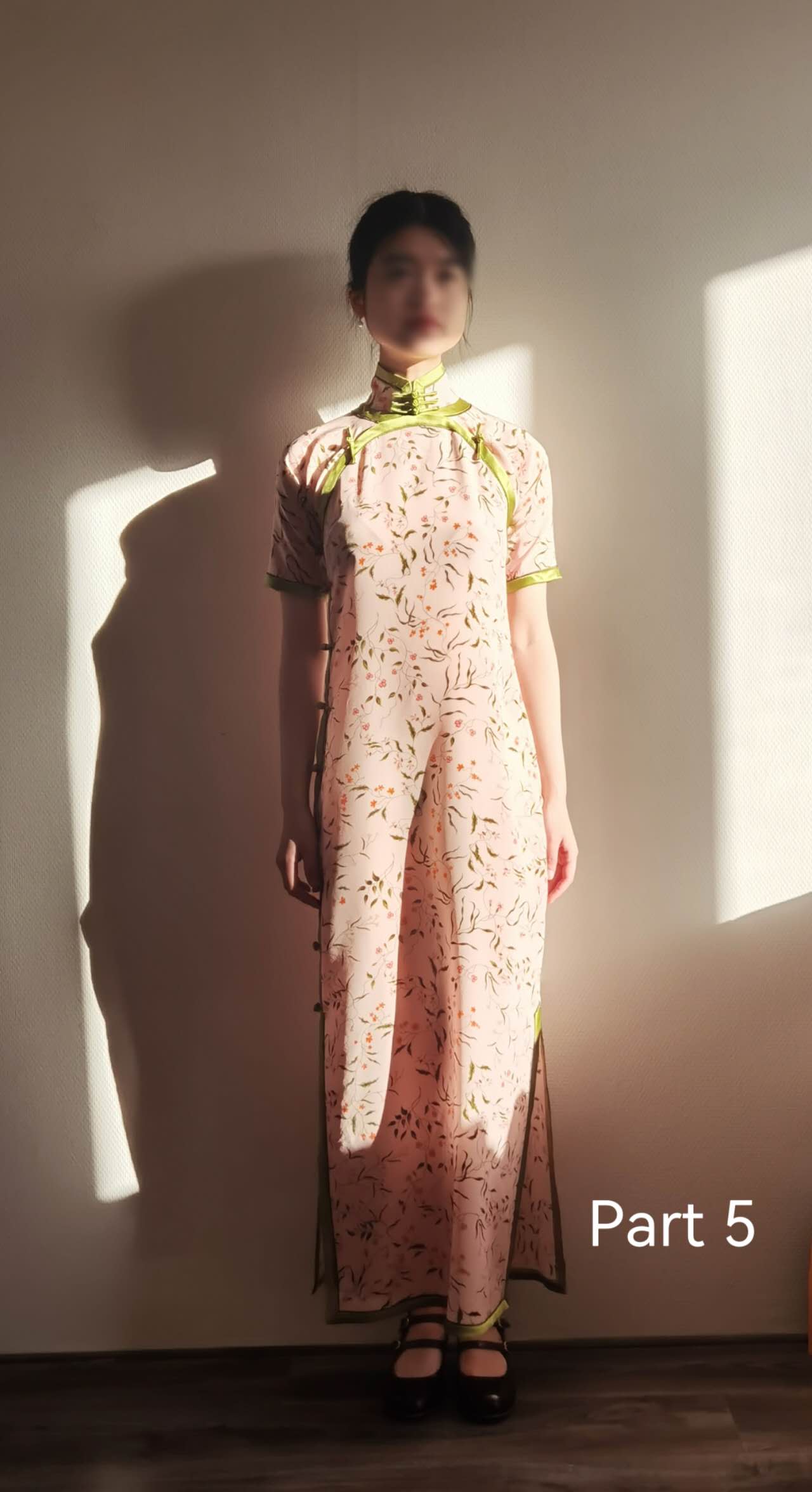
Prewash and press all the fabrics you plan to use.
Traditionally, the fabric is folded twice—vertically and horizontally—so that only a quarter of the whole pattern (e.g. front right) would be drawn onto the topmost layer. The folded fabric is also pulled, pinched and shaped with steam so that when it is cut, the piece would come out slanted as described in Part 1 and with extra length in the front to accommodate the bust. Other makers prefer to draw the front and the back separately, or even the entire pattern, before cutting. Some makers thread-trace the entire piece anyways, so drawing out the entire pattern would not really be an extra hassle.
I use a disappearing ink pen to draw the pattern, and thread-trace everything, including any marks. This is because the ink usually disappears sooner than I am able to complete the qipao, especially if I steam-shape the fabric in the sewing process. In my experience, it is okay to iron areas with disappearing ink (even if the packaging says otherwise), but do test first on a scrap of fabric.
I suggest leaving a wide seam allowance for areas above the hips, so that you can adjust the fit if needed. You might have noticed that seam allowances are unnecessary along some edges. I just prefer to keep them at this stage and trim later.
I leave the neckline traced but uncut until I am ready to finish it.
In addition to the main body piece, you would need to cut the collar and the modesty panel. The collar needs to be cut from the main fabric, the interfacing and the lining.
Last but not least, you will need to cut out the bias tapes for the binding and decoration, if you are making them yourself. It is optional to pre-fold and press them at this point.
Leave a Reply
You must be logged in to post a comment.